
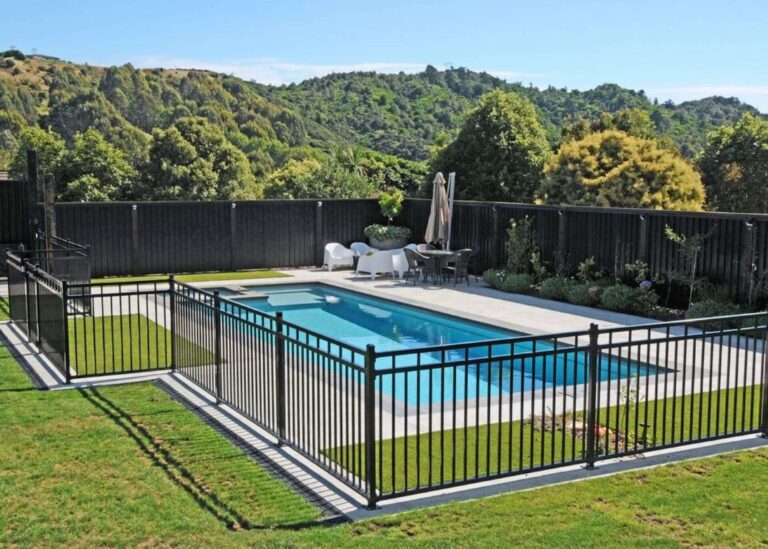
- Pools that can be filled to 400 mm deep or more must have a barrier that restricts access by unsupervised children under 5.
- The standard design (F9/AS1) needs a barrier at least 1.2 m high, with no gap a 100 mm sphere can pass through.
- Gates must self-close and self-latch, and nothing climbable should sit outside the fence.
- New or altered swimming pool barriers generally need a building consent.
Which pools need a barrier?
Since the Building (Pools) Amendment Act 2016, pool barriers are controlled by the Building Act 2004 and Building Code clause F9, Means of restricting access to residential pools. Every residential pool that can be filled with water 400 mm deep or more needs a barrier that restricts access by unsupervised children under five. That includes many inflatable and temporary pools. Spa pools can instead use a compliant lockable cover (F9/AS2).
What the barrier needs
The Acceptable Solution F9/AS1 sets out a design that councils accept. The key points:
- Height: at least 1.2 m above the ground outside the barrier.
- Gaps: no opening a 100 mm sphere can pass through, including under the fence.
- Climbability: horizontal rails on the outside must be spaced far enough apart that a child can't climb them, and there should be no climbable objects (pots, furniture, trees, a barbecue) within 1.2 m outside the barrier.
- Gates: open away from the pool, self-close and self-latch from any position, with the latch out of a small child's reach.
- Pool area: only things related to the pool belong inside it, so no washing lines or vegetable gardens.
Can a boundary fence be part of the pool barrier?
Yes, if it meets all the same requirements, including the climbability rules on the neighbour's side. That often means agreeing changes with your neighbour.
Do you need a building consent?
Building or altering a swimming pool barrier generally needs a building consent. All the work must comply with the Building Code, whether or not it needs a consent. Councils also inspect pool barriers periodically.
Choosing a pool fence
Aluminium and steel panel fences, glass, and purpose-built timber or slat barriers can all comply. The detail is what matters: rail spacing, gaps, gate hardware and the ground underneath. We build pool fences in black aluminium and panel systems. See examples in our gallery.
This guide is general information. Your council has the final say on pool barrier compliance.