
Frequently Asked Questions
Straight answers about fencing, retaining walls, earthworks, consents and resin driveways in Canterbury.
Quotes, Pricing & Getting Started
How long does a typical project take?
Most fencing and retaining wall jobs take between 3 and 10 working days on site. Resin bound driveways usually take 1 to 3 days. Earthworks depend on volume and access. Small jobs can often start within a couple of weeks. We'll give you a realistic timeframe with your quote.
Are you licensed and insured?
Yes. We're fully licensed and insured, and we're SiteWise Gold accredited. SiteWise is Site Safe's health and safety prequalification system, and Gold is reserved for contractors who score 90% or more on the annual assessment.
Do you provide free quotes?
Yes. We come to your property for free, look at the ground, access and drainage, and give you a fixed-price, no-obligation quote. Call 027 233 6246 or request a quote online.
Do you give prices over the phone?
We can talk ballpark over the phone, but every job is different: ground, access, drainage and materials all change the price. A free site visit means we can give you a fixed price you can rely on.
What areas do you cover?
All of Christchurch, the Port Hills, Banks Peninsula, Selwyn and Waimakariri, plus wider Canterbury for larger rural and subdivision projects. We're based in Tai Tapu.
Fencing
Do I need a building consent for a fence?
Usually not. A fence up to 2.5 metres high doesn't need a building consent, but pool barriers do. Height is also controlled by the district plan: in Christchurch a permitted fence is typically 1.8 m on the road boundary and 2 m on side and rear boundaries. Taller fences may need a resource consent. See fence height rules.
What affects the price of a fence?
Length and height, the style and material, ground conditions (rock, stones or slope), access, removing the old fence, the number of gates and corners, and whether any retaining is needed. We give a fixed price after a free site visit.
Who pays for a boundary fence?
Under the Fencing Act 1978, neighbours generally share the cost of an adequate boundary fence equally. If you can't agree, a formal fencing notice gives your neighbour 21 days to object with a cross-notice. Some new subdivisions have fencing covenants that change this. Read who pays for a boundary fence.
How long does a new fence take?
Most residential fencing jobs take between 3 and 10 working days on site, depending on length, ground conditions and whether old fencing needs removing first.
What's the best timber for a fence in Canterbury?
Treated radiata pine is the reliable, cost-effective choice. We use H4-treated posts in the ground and H3.2 rails and palings above ground. Macrocarpa and hardwood give a premium natural look. Your quote will spell out exactly what we're using.
Do you build gates and automatic gates?
Yes. We build pedestrian gates, driveway gates and sliding gates, including steel-framed gates clad to match your fence, and we install automatic gates.
Do you install panel and slat fencing systems?
Yes. As well as timber, we install modern panel, slat and colour steel systems, including Boundaryline fencing systems. Our gallery has examples.
Can you fence steep hill country?
Yes. A lot of our rural work is on Banks Peninsula and Port Hills hill country. We plan the line around the contour, use proper strainer assemblies on every change of direction and pin them on the up-pull side so they don't lift.
What's a strainer assembly and why does it matter?
Strainers are the anchor posts at ends, corners and gateways that hold the wire tension. A stay fixed about a third of the way up the post, and a pin (dead man) driven on the up-pull side, stop the strainer leaning or lifting. Get the strainers wrong and the whole fence goes slack. It's the part we never skimp on.
Retaining Walls & Gabions
Do I need a building consent for a retaining wall in Christchurch?
A wall that retains 1.5 metres of ground or less, and carries no extra load (surcharge) above it, is exempt from building consent under Schedule 1 of the Building Act. Walls retaining more than 1.5 metres, or any wall with a driveway, building, steep slope or other load above it, need a building consent and usually engineering design. Exempt walls must still meet the Building Code, and resource consent rules can also apply. We sort this out for you. See our full consent guide.
What is a surcharge on a retaining wall?
A surcharge is any extra load on the ground behind the wall: a driveway or parking area, a building, a fence, a steep slope above, or even a neighbour's retaining wall close by. A surcharged wall has to be designed for that load, which is why it needs a consent at any height.
Timber or gabion: which is better?
Timber pole walls are faster and more economical for low to medium walls and suit most residential sections. Gabion walls are heavier, free-draining and flexible, which makes them excellent on steep slopes and for taller walls. Read our timber vs gabion comparison.
Why do retaining walls fail?
The most common cause is poor drainage: water builds up behind the wall and pushes it over. Other causes are shallow or undersized poles and footings, loads the wall wasn't designed for, poor construction, and the wrong wall type for the soil and slope. Every wall we build has a drainage plan.
Can you fix or replace a leaning retaining wall?
Yes. We assess failing walls, remove and replace them, or build a new engineered wall in front where that's the better option. We can put our assessment in writing, which helps when you're talking to your insurer.
How long does a retaining wall take to build?
Most residential retaining walls take 3 to 10 working days on site. Engineered walls need design and consent time first, which we organise.
Do you do the excavation as well?
Yes. We dig the site cut, build the wall, install drainage and backfill, all with our own machines. One crew is usually faster and cheaper than separate earthworks and wall contractors.
What is a gabion wall?
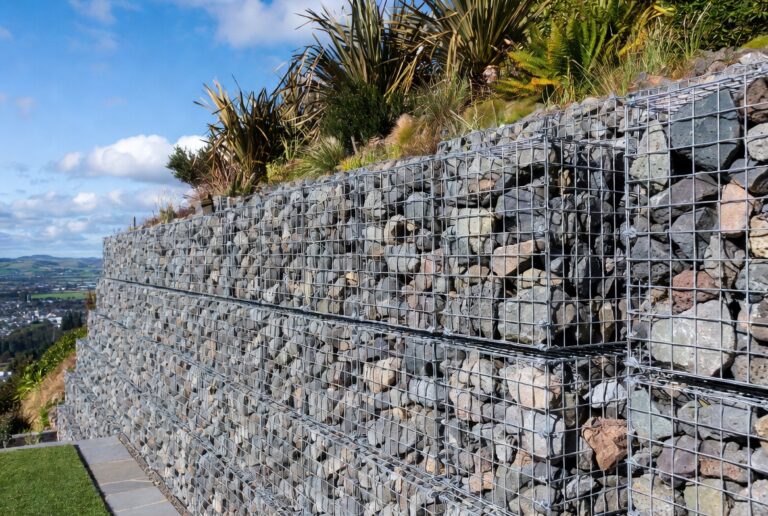
A gabion wall is built from heavy wire-mesh baskets filled with rock and stacked to retain soil. The weight of the rock holds the ground back, and the gaps between stones let water drain straight through.
Are gabion walls good for the Port Hills?
Very. They're free-draining, so water doesn't build up behind them in wet loess soils, and they flex slightly with ground movement instead of cracking. That makes them one of the best choices for steep Port Hills and Banks Peninsula sections.
Earthworks
How much do earthworks cost?
It depends on the volume of soil, access, ground conditions and how far spoil has to go. Once we've seen the site we give you a fixed price, not an open-ended hourly estimate.
Do I need consent for earthworks?
Sometimes. Christchurch City Council and Selwyn District Council set limits on earthworks volume and depth, with stricter rules on the Port Hills, in hazard areas and near waterways. We'll tell you at the quote if consent is likely and can help organise it.
Can your digger get into a tight section?
Yes. Our 1.7-tonne mini excavator fits through a standard gate and works on steep, restricted sites. For bigger jobs we bring larger machines.
Do you take the soil away?
Yes. We cart spoil with our own tipper truck, or reuse it on site for levelling and backfill where it's suitable.
Resin Driveways
What's the difference between resin bound and resin bonded?
Resin bound surfacing mixes the stone and resin together and trowels it smooth, giving a permeable, loose-stone-free finish. Resin bonded scatters stone onto a layer of resin, so it isn't permeable and loose stones can come away. We install resin bound.
Can resin go over my existing driveway?
Often, yes. Resin bound surfacing can be laid over sound existing concrete or asphalt. If the base is cracked or failing, we can prepare a new base first. We do the earthworks too.
How long does a resin driveway take?
Most resin driveways take 1 to 3 days, depending on size and base preparation.
Is resin bound good for drainage?
Yes. It's permeable, so rainwater drains straight through instead of pooling or running off. That helps on sloping sites and reduces stormwater load.
Still Have a Question?
Call 027 233 6246 or send us a message. We're happy to help.